MLOps are known for handling automation processes for the entire lifecycle while DevOps is known for handling code. So there is a big difference between the two. If you are looking to build automated ML pipelines, scalable AI platforms and future-ready machine learning systems, don’t worry, you have landed on the right page!
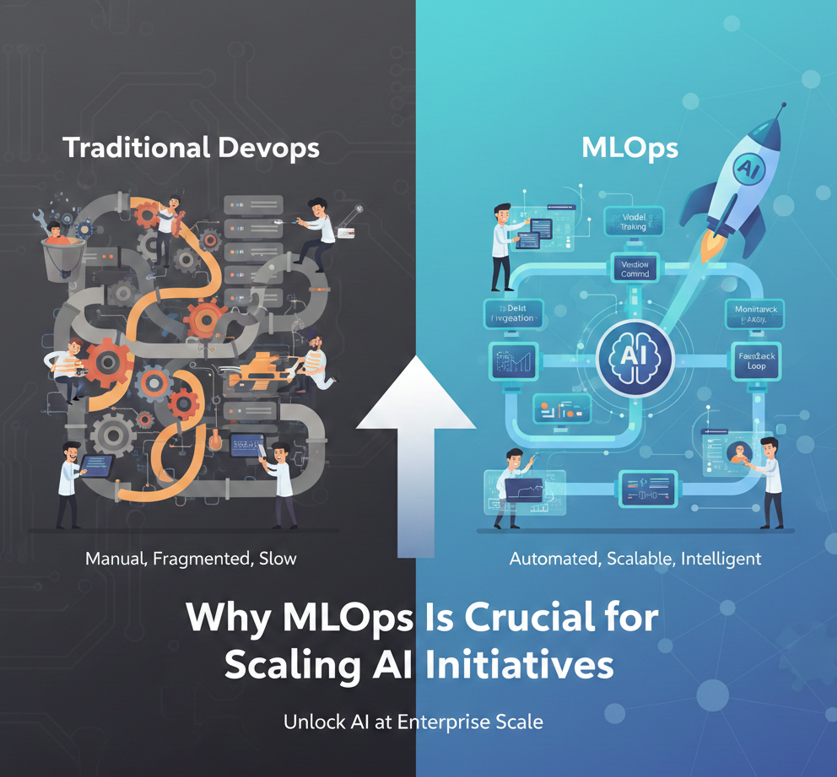
In this guide, we will walk you through how MLOps is crucial for scaling AI initiatives and how you can create reliable AI systems.
What Are MLOps?
MLOps is a practice that combines machine learning, DevOps and data engineering to manage the ML lifecycle in production. MLOps is built for machine learning systems. Overall, MLOps handles tasks that challenge DevOps. Let’s know some of the tools in MLOps.
- MLFlow: Tracking and model registry
- KubeFlow: ML workflows on Kubernetes
- TensorFlow: Production ML pipelines
- Amazon SageMaker: End-to-end managed ML service
- Azure Machine Learning: Cloud ML lifecycle platform
MLOps focuses on models, data, model versioning, CI/CD, and data drift monitoring. MLOps is a modern approach that people adopt to automate, improve model quality, and accelerate time-to-market.
Why does MLOps matter?
Machine learning operations handle the entire development lifecycle. It bridges the gap between developing machine learning models and deploying them reliably into production. Let’s understand the key aspects of MLOps that matter.
- Prevents Quiet Model Failures: MLOps provides active monitoring of data before they lead to disruptions in the cycle or business decisions.
- Accelerates Deployment Velocity: It helps automate the development lifecycle, which can take months to deploy, to days with automated deployments.
- Boosts Team Productivity: The automated process allows the team to focus on prioritising work rather than spending time on automation tasks.
- Enables Scalability: It allows organizations to manage hundreds or thousands of models, rather than just a few, without proportional increases in manual effort.
MLOps Vs DevOps
Let’s understand both operations, how they differ, and what tools they use differently.
MLOps
Machine learning operations is a set of practices that automates tasks. Including data processing, model training, tracking model version, monitoring model performance, and building collaboration among data scientists, DevOps engineers and IT professionals.
Key Features:
- Data management and versioning
- Experiment tracking
- Automated ML pipelines
- Model Registry
- Continuous Integration/ Continuous Deployment
- Model Deployment and Serving
- Monitoring and Drift Detection
How they help:
- Reduces manual work in data preparation, training, validation and deployment
- Monitors models in production and detects data
- Enables monitoring, logging, and altering to catch issues early
- Makes AI systems reliable enough to become core product features
- It brings a collaborative environment among team members with a standardised workflow
DevOps
DevOps is a set of practices that combines software development and IT operations to deliver applications faster, more reliably and with better collaboration.
Key Features:
- Automatically builds and tests code when changes are made
- Manages infrastructure using code instead of manual intervention
- Breaks the confusion between the development and operation teams
- Enables scalable deployment on cloud platforms
- Embeds security checks into CI/CD pipelines
How they help:
- DevOps helps in speeding up software delivery cycles
- Automated testing reduces bugs in production
- Aligns developers and operations toward shared goals
- Easily handles growth in users and traffic
- Automation reduces manual effort and overhead costs
What MLOps Ads That DevOps Doesn’t
MLOps for machine learning deployment, while DevOps for software delivery. Let’s understand the structure process for MLOps and how they handle DevOps work.
End-to-End ML Lifecycle Automation
Machine learning operations handle data preparation, training pipelines, and deployment pipelines. MLOps handles the entire lifecycle from the development stage to deployment with minimal manual intervention and minimal costs.
Experiment Tracking and Reproducibility
MLflow, Kubeflow are some of the tools for managing the machine learning lifecycle. It is designed to help data scientists organize their work and leverages scalability.
Model Monitoring and Drift Detection
MLOps are known for continuously monitoring prediction accuracy, input distribution changes, latency and performance. It also enables alerts when performance drops, shadow deployments, and A/B testing for models.
Governance Compliance
Machine learning learns from data, which might include lots of sensitive data, which leads to threats and cyber fraud. MLOps supports model lineage tracking, audit logs, and reproducible training pipelines.
Scalable Infrastructure for Multiple Models
As an organization expands, they deploy multiple models, multiple versions, and multiple environments. MLOps manages model registries, version control for models, and container orchestration.
MLOps Real World Use Cases
MLOps is now a modern approach which is adopted by many industries. Let’s know some of the top industries.
E-Commerce
Ecommerce websites are run for users who like online shopping. Ecommerce uses MLOps for studying user behavior, which helps them to fill the stalks out.
How MLOps Helps:
- Automates data pipelines from clickstreams
- Tracks model experiments to test new algorithms
- Deploys real-time recommendation APIs
- Monitors model accuracy and input distribution changes
Banking
Fintech or banking service applications run on lots of sensitive data, which leads to risk like cyber frauds or threats. With AI systems, users can detect fraudulent transactions in real-time and adapt to evolving fraud patterns.
How MLOps Helps:
- Versioning datasets for historic transactions
- Automates fraud detection
- Provides monitoring dashboards to track false activities
Healthcare
Modern healthcare applications bridge the gap between doctors and patients. This modern approach reduces frequent visits to clinics, while doctors can now study reports visually and can interact with patients via calls, video calls.
How MLOps Helps:
- Manages data compliance (HIPAA, GDPR)
- Monitors deployed models for accuracy decay
- Automates retraining pipelines with new datasets
Supply Chain
Supply chains can now predict product demand to optimize inventory and adapt forecasts to seasonal or market changes.
How MLOps Helps:
- Handles ingestion of historical and real-time sales data
- Monitors prediction accuracy and alerts if forecasts device
- Supports multiple models across regions and product lines
DevOps VS MLOps Comparison Table
Let’s understand the comparison between DevOps and MLOps through the table below.
| Capability | DevOps | MLOps |
| Code CI/CD | Yes | Yes |
| Data Versioning | No | Yes |
| Model Registry | No | Yes |
| Drift Monitoring | No | Yes |
| Continuous Training | No | Yes |
When Should Organizations Adopt MLOps?
Organization staff must be confused about at which stage you should adopt MLOps, we have listed some of the reasons why you need to acquire MLOps.
- More than 2-3 production models
- Frequent retraining required
- Cross-team ML collaboration
- Compliance needs
- Scaling AI across departments
Conclusion
While DevOps development enables faster software delivery and supports DevOps for AI development, it does not fully address the complexities of managing data-driven models. The importance of MLOps in AI lies in its ability to automate, monitor, and scale the entire machine learning lifecycle. Overall, making MLOps essential for scaling AI initiatives beyond traditional DevOps.